


10/11/2025
7 things you probably don’t know about Madrid
(and if you do, maybe you’re still surprised)
Madrid is a city full of history, hidden gems, and fascinating facts that even if you live here your entire life, you might not know. The capital holds secrets that many are unaware of, even locals!
At BYPILLOW, we want to introduce you to some of Madrid’s most amazing curiosities that you probably didn’t know. Are you ready to join us on this unique tour of the city? Oh, and remember, if you’re looking for the best hotels in central Madrid for an unforgettable experience, BYPILLOW has the finest selection. You’ll be amazed!

The world’s oldest restaurant is in Madrid
If you thought restaurants with centuries of history only existed in Paris or Rome, you’ll be surprised to learn that Madrid is home to the world’s oldest continuously operating restaurant, according to the Guinness World Records. It’s called Sobrino de Botín, founded in 1725, a place steeped in history where artists, writers, and famous figures have dined.
The legendary Francisco de Goya worked here as a dishwasher before becoming one of the most important painters in history. Additionally, writer Ernest Hemingway mentioned the restaurant in his novel The Sun Also Rises, describing it as one of the best places to enjoy a delicious roast suckling pig.
If you visit Madrid and want to savor traditional dishes in a historic setting, Botín still serves century-old recipes, thanks to its famous wood-burning oven, which has been in operation for nearly 300 years.
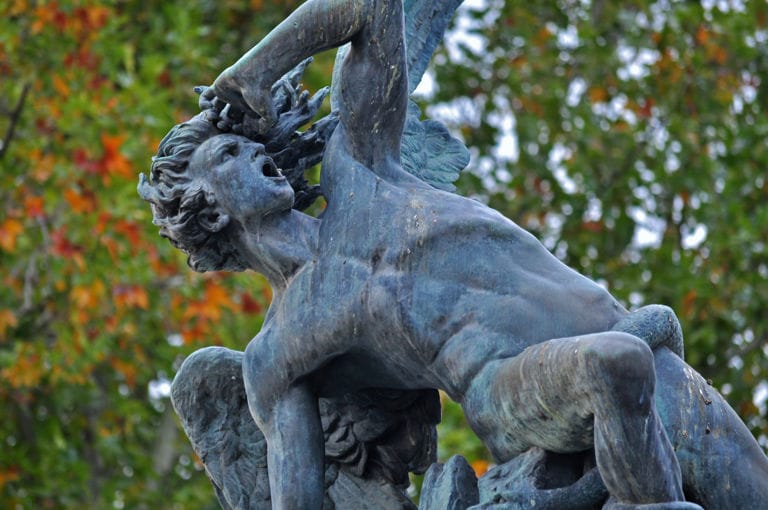
The world’s only statue dedicated to the devil
It may sound unbelievable, but Madrid is one of the few cities in the world with a statue dedicated to the devil. In Retiro Park, you’ll find the Monument to the Fallen Angel, a work by Ricardo Bellver, depicting Lucifer at the moment of his expulsion from heaven.
What’s truly fascinating is that the statue is placed exactly 666 meters above sea level, a number traditionally associated with the devil. This coincidence has sparked all kinds of urban legends, turning the sculpture into a must-see for mystery lovers.
Despite its theme, the artwork is a masterpiece, and rather than evoking fear, it has become one of the most photographed monuments in Retiro Park.

The Temple of Debod: A gift from Ancient Egypt
As you stroll through Madrid, you might be surprised to come across an Egyptian temple that’s over 2,000 years old. This is the Temple of Debod, a gift from the Egyptian government to Spain in 1968, as thanks for its help in rescuing the Nubian temples, which were at risk due to the construction of the Aswan Dam.
Originally, this temple was located in the region of Debod, near the Nile River, and was dismantled stone by stone to be transported to Madrid, where it was reassembled. Today, it is one of the few Egyptian temples outside Egypt and a perfect spot to enjoy one of the city’s most magical sunsets.
What’s most surprising? Some of its inscriptions and reliefs still retain original details, and inside, you can learn more about its fascinating history and significance. It’s a must-see in the capital! Did you know its story?

The tradition of eating twelve grapes on New Year’s Eve
Every December 31st, thousands of people follow one of the most well-known New Year’s traditions: eating twelve grapes to the rhythm of the bells ringing in Puerta del Sol in Madrid. But did you know this custom originated in the Spanish capital in the late 19th century?
There are two versions of its origin:
- One story says that in 1909, there was a surplus of grapes in Alicante, and the grape-growers came up with this strategy to sell more fruit, promoting the idea that they would bring luck if eaten with the bells. However, historical documents show that the tradition existed before that.
- Another theory suggests that the upper class in Madrid used to celebrate the New Year with champagne and grapes, French-style. As a mockery of this aristocratic custom, in 1895, some Madrid locals decided to gather at Puerta del Sol and eat grapes along with the bells. What started as a humorous protest turned into a tradition that today symbolizes New Year’s all over Spain.
Each grape represents a wish or goal for the twelve months of the year, and the tradition says that if you manage to eat them all without choking, you’ll have a prosperous and lucky year. Tradition, superstition, and fun all in one! And if not, just watch your granddad with his mouth full of grapes and try not to laugh!
The origin of the name "Madrid" is linked to water
The origin of the name Madrid hides a story that dates back to the time of Muslim rule on the Iberian Peninsula. It comes from the Arabic term “Mayrit” (or “Magerit”), which means “place of abundant waters.”
Why this name? In medieval times, the area where Madrid stands today was filled with streams, springs, and underground watercourses. The Muslims built a fortification in the 9th century in what is now the Almudena area, and thanks to their water channeling system, the city thrived.
Although over time “Mayrit” evolved into Madrid, its connection to water remains. Evidence of this is the Bear and the Strawberry Tree, the city’s symbol, which originally depicted a bear drinking water, referring to this natural abundance.
Interestingly, remnants of the old streams and springs still exist, and some buildings in the city center retain wells or underground passageways that once supplied water to the city in ancient times. So, the next time you walk through Madrid, remember that you’re walking through a city that, in its origins, flowed with water everywhere.
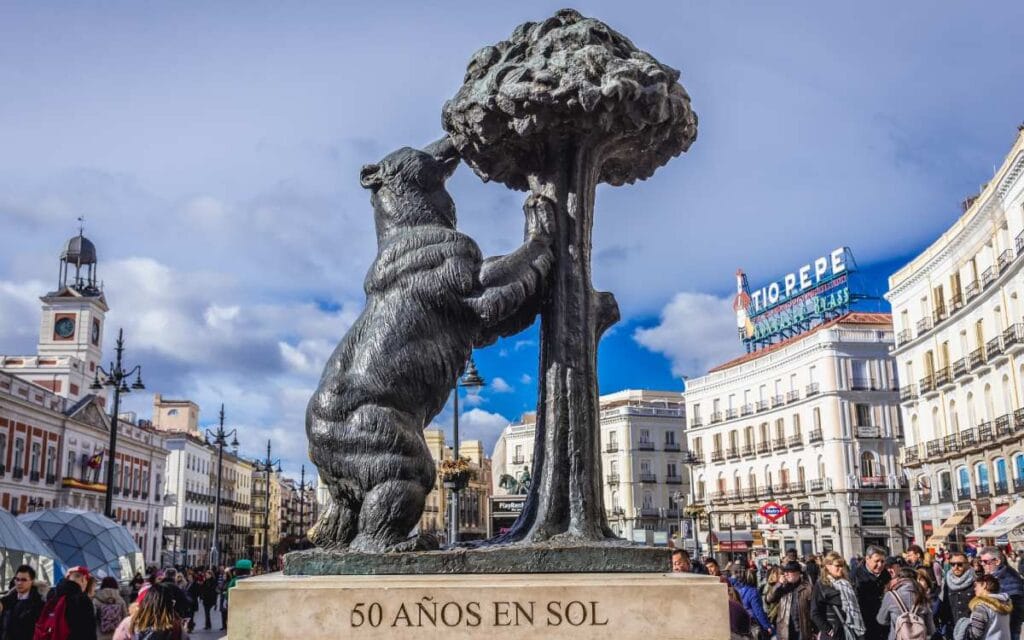
The Bear and the Strawberry Tree might have been a female bear
The Bear and the Strawberry Tree is the emblem of Madrid and one of the city’s most iconic images. However, what many don’t know is that it could have been a female bear instead of a male one.
This theory is based on historical documents where the animal is referred to as “osa” (female bear) rather than “oso” (male bear). Some historians believe this linguistic confusion arose because, in the Middle Ages, the feminine term was more commonly used to refer to these animals in general. However, over time, the masculine term became more popular, and the symbol was established as we know it today.
Beyond the animal’s gender, its presence in Madrid’s coat of arms has fascinating roots. In the Middle Ages, the area around Madrid was surrounded by vast forests, and bears were a common species; meanwhile, the strawberry tree symbolizes the region’s natural wealth. Additionally, the coat of arms reflects an old conflict between Madrid’s City Council and the Church Council over control of the city’s forests and pastures.
So, the next time you come across the Bear and the Strawberry Tree statue at Puerta del Sol, remember it might have been representing a female bear and not a male one.
Madrid has an invisible river
Madrid doesn’t just have the Manzanares River—it also hides a nearly unknown underground river: the Arroyo de Leganitos. Although it’s not visible today, it still flows beneath the city streets.
This stream was once an open-air watercourse. But over the years, it was buried under the asphalt as Madrid expanded. However, its traces can still be found in key spots throughout the city. Places like the Royal Palace and Plaza de España still preserve remnants of this ancient watercourse, which used to supply water to the population during medieval times.
The Arroyo de Leganitos was vital to ancient Madrid, as it provided water to mills and orchards. Even today, during heavy rainfall, some leaks in certain basements and underground tunnels in the city serve as reminders that this hidden river still exists.
Madrid hides more water than we might imagine, and although the Arroyo de Leganitos isn’t visible, it continues to flow silently beneath our feet.
At BYPILLOW, we encourage you to discover the capital in an original, different, and truly curious way.. You can stay at our hotels in central Madrid and enjoy a stay that combines comfort, modernity, and an unbeatable location.
For example, our BYPILLOW Crosstown accommodation is a hostel in Lavapiés, one of the city’s most popular and bohemian neighborhoods. If you’re visiting the capital with your family, we recommend BYPILLOW The Citadel, a hostel in Madrid’s historic center where you can walk to the city’s main treasures. Lastly, the crown jewel: BYPILLOW Velázquez 45, located just a short walk from Retiro Park, the Prado Museum, and Puerta de Alcalá.
Come explore the capital and enjoy stories as surprising as the ones we’ve shared in this post!